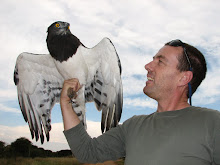
Uganda Ringing Expedition
14th Jan to 2nd Feb 2012
Leader Malcolm Wilson
Participants
Richard Charles
Richard Dobbins
Wendy James
Dyfed James
Dawn Jay
Nathan Eluku
Overview
Our expedition was to follow the previous year, a few days at some sites around Kampala, then off to the Budongo Forest field station, then on to the Nile at Murchison Falls National Park to collect ringing data on Grasshopper Buzzards as part of my on-going research project as well as run my 15 year old mist-netting site at the Lodge.
We would then head south to Kibale Forest National Park where my resident friend, Primatologist Julia Lloyd, owns newly acquired land adjacent to the Forest where we were to initiate a ringing site to look at species composition and change over time as the land reverts back to forest from farmland.
South again, to Queen Elizabeth National Park where we break up the journey for a night to stay at a bushcamp on the banks of the Kazinga Channel with the idea of doing a slow drive the next morning to catch birds of prey along the Ishasha road.
Then 2 nights in Bwindi Impenetrable Forest National Park where the group will go to trek Mountain Gorillas, the grand finale!
Back to Queen Elizabeth National Park again to do raptoring in the southern sector for an afternoon and the following morning work the Ishasha road again and then back to Kampala.
I arrived in Entebbe earlier than the rest of the team on the 11th January in order to get letters of permission from the Uganda Wildlife Authorities and to do the shopping for provisions for our stay in Budongo forest.
Entebbe
One afternoon on the 13th I had a bit of time and decided to set nets in the garden to try and catch a pair of African Hobby which had a favourite staging perch in a tall tree at the end of the garden. Occasionally these two falcons would be joined by upto three European Hobby, so quite a lot going on. I managed to catch a Slender-billed Weaver and put this in a Bal-chatri trap under the net, but to no avail. My best chance was that they would drop low enough to snatch a dragonfly near the nets!
As well as the Hobbies, there were some very vociferous Splendid Glossy Starlings which were coming into the large fig tree by the veranda. I had set 2 x 60 foot nets across the lawn for the Hobbies and realised they were perfectly positioned to anticipate the bird’s trajectories when they all took off periodically. As well as the starlings there was a flock of Meyer’s Parrots which also had similar flight paths. It wasn’t long before I had one of these beautiful starlings and then a surprise Double-toothed Barbet went in, terrifying bill as its name suggests and a case of mind over matter when extracting!

But then next I was very happy to get one of the Meyers Parrots in the net and forgave all pain inflicted by the previous Barbet when this thing started in on my fingers! Nice colourful African birds to start with and as a bonus ended up the evening with a cracking Woodland Kingfisher!
Lweza Hill and ‘The magic Garden’
The previous evening Nathan joined me in Entebbe, Nathan, who is Ugandan, has been with me on trips for nearly 15 years and is a wonderful chap, extremely helpful and a good ringer, doing these trips without him would be quite daunting.
We picked up the team from their Hotel and set off to a new site on the Entebbe-Kampala road. Got the Landcruiser down a tiny track, then along a footpath for a while to the site and set a couple of lines up.
Very soon we got a few nice birds including Garden Willow and European Reed Warblers, a Great Reed Warbler, Pygmy Kingfisher, Grey-capped Warbler, Snowy-headed Robin-chat and Yellow-throated Leaflove.
Packed up late morning and set off for Kampala and ‘The Magic Garden’ of my dear friends Roger and Kathy.
Got the nets up and the team were soon scratching their heads, trying to identify female sunbirds of which 13 species occur in the garden!
As we had sundowners on the veranda, a selection of African and European Hobby’s put on a spectacular display catching dragonflies.
Two mornings here produced some great birds, a young African Goshawk finally went into the net after harassing the garden, two Shikra also upped the raptor total and a retrap European Reed Warbler from almost exactly a year ago.
Higlights from the garden included White-browed Coucal, Splendid Glossy Starling, Green-headed, Scarlet-chested, Red-chested, Olive-bellied and Variable Sunbirds.
At sundowners we watched the Hobbies and were treated to great views of a pair Ross’s Turaco, Black and White-casqued Hornbills and a flock of noisy African Grey Parrots.
Budongo Forest
Set of after a couple of net rounds and had just left the house when we dropped for a Lizard Buzzard perched on a pole next to the track. He came in for the mouse and we would have had him but for a member of the public flushing the bird off the trap.
Getting out of Kampala was hard going, what with all the traffic but enjoyed the madness and chaos from the security of our formidable land-cruiser with extra crash bars!
On the way we had spotted several Lizard Buzzards, a few Long-crested Eagles which we tried for, a couple of Brown Snake Eagles and a few wahlberg’s eagles but mostly too difficult to drop for. But halfway to Masindi we spotted a Western Banded Snake Eagle on a pole and going into drop the trap it flew to a tree, even better. Had the bird on the trap in minutes and our first eagle in the bag!

Got to Budongo Forest and the Field Station and were warmly met by Geoffrey the co-ordinator and met the vets who would be with us to to take parasite and fecal samples. Also joining us were the resident field assistants from Sonso whom we were to teach ringing principles to.
Not wanting to lose any time we got 10 x 60 foots up and soon the group were handling birds they had never seen before! Dusky Elminia, Brown-chested Alethe, Red-bellied Paradise Flycatcher and Fire-crested Alethe.
Over the next 5 days we were rewarded with some awesome birds. In particular one stands out which was the capture of a forest denizen that confounds most bird watchers as it calls hauntingly from its hidden perch high in the canopy, a Chocolate-backed Kingfisher. For this species to have come low enough to get caught in a mist net, it would have to have been distracted and what a distraction, not 10 ft away in the next net was a Blue-breasted Kingfisher!!


We set a small double panel net over the stream pool and caught over 50 White-headed and Black Saw-wings. As well as this we caught plenty of Lesser-striped and Barn Swallows, but the real gems from this site were sadly not present.
Nathan set his 60 x 40 net in its usual spot along the stream and across it and is now called ‘Nathan’s 100’ as it really does turn up some cracking birds. First off were 3 Shining Blue Kingfishers, several Tambourine Doves, Red-tailed Greenbul and few cracking Dwarf Kingfishers.
Changing our first net location we setup at a new site off the famous ‘Royal Mile’ in dense forest whilst still being able to run the Stream and Nathan’s 100 nets with the assistance of doing net rounds using a rangers motorbike.
Eventually Nathan came back from the Stream sites and was all dead pan as usual until he cracked his huge big grin and the pulses went mad! At last among the swallows we got our first of 12 Sabine’s Spinetails, another rarely if ever caught canopy species.
Last year we had netted in an area of cleared forest which was covered in the invasive Lantana plant, making great thickets to net in. Unfortunately this area was not so productive but did catch a few Winchat, Barn Swallow and Brown Illadopsis. Last year it caught a European Blackcap, a first for Budongo Forest.
A few new species added to the ringing list from past trips included Yellow Longbill, a great little warbler and really well named. Several Grey-headed Negrita were caught which for a common bird had surprisingly eluded me till now. Western Nicator, always heard and seldom seen were caught, and a real bogey bird for me, Blue-shouldered Robin-chat, two caught in Nathan’s 100.
Did well for Woodpeckers with a few of Buff-spotted, Yellow-crested and Brown-eared and a Yellow-billed Barbet was pretty special as were a couple of Dusky Long-tailed Cuckoos.
During some of the quieter moments we managed to do a bit of birding from the ringing table, had Cassin’s Eagle, Honey Buzzard, White-thighed Hornbill, Purple-throated Roller, Ituri Batis, Chestnut-capped Flycatcher, Rufous-crowned Eremomela, Black-collared Apalis and Forest Flycatcher.
Murchison Falls National Park
It was hard to leave this site but new and further excitement beckoned on the Nile. On the way we almost got a Lizard Buzzard which managed to get off the trap and driving into Masindi dropped for 4 out of 6 Wahlberg’s Eagles, but were too early for them and were not tempted to disrupt their early morning pontificating.
Got into the National Park and after a while spotted a Buzzard in a tree not too far off. Dropped a trap and backed off to wait. Whilst waiting I realised that this was no ordinary Steppe Buzzard as expected in this area but were dealing with a Red-necked Buzzard! The bird eventually flew in to a dead tree above the trap but after a while flew off uninterested, phew!
A great sign was that there was burning in the savannah which meant that there would be Grasshopper Buzzards in from their West African breeding grounds.
A while later we saw a Grey Kestrel, a good drop from about 100m off and in it came and was caught in moments.
Heading to the top of the falls we spotted our first Grasshopper Buzzard a way off at the Buffalo waterhole where several old gentlemen were cooling their large bulks.
The Top of The Falls as usual was incredible, never fails to strike awe into me as the mighty Nile thunders through an 8m gap to 100m below in a raging violent force. Quite a few Rock Pratincoles on the top rocks and an Osprey flew over with a large fish.
Backtracking, we spotted the Grasshopper Buzzard at the waterhole in a nearer position and got a trap down and had it in minutes! Whilst ringing the bird a new crowd of Buffalo decided to join the others in the water, wandering across the track some 40m away, focused ringing by Wendy who did the honours!
Saw an adult Beaudouin’s Snake Eagle overhead and an adult Martial Eagle which we tried to temp to no avail. Good to see healthy numbers of Bateleur, such an iconic bird of the African savannah.
Got to our camp on the banks of the Nile and had a very welcome cold beer and watched the Elephant and Hippos across the water.
Quickly had the nets up and were soon getting to grips with a catch of Red-winged grey Warblers, this species is a representative of the Guinea-Sudanian savannah of the north and at its southern range here. Also had a couple of European Reed Warblers and a lovely Grey-headed Kingfisher.


Over the next few days we caught some great birds in the nets including two retrap European Reed Warblers, one from last January and the other from March 2008!
One of the best things we did was to play the calls of Northern Carmine Bee-eater, a bird one only can dream of catching, but we got 4!! They responded to the ipod and speakers.
One evening Rich came back to the ringing table with a big grin on his face and presented me with another dream bird, a Red-necked Falcon, oh-my-gosh! It had gone into a line of nets Nathan had put up as he does, he’s getting good at this!
Other new birds for the site were the rather smart Chestnut-crowned Sparrow-weavers, Bar-breasted Firefinch and Scaly-throated Honeyguide, the former 2 also being an indicator of the Guinea-Sudanian savannah system.
We took the very beleaguered ferry across the Nile to the North bank to look for raptors. The habitat here changes dramatically and we were soon in beautiful Borassus Palm savannah stretching to the far horizon.
We found a stunning Abyssinian Roller next to the track and well worth getting the spring trap out for, only to discover that the giant mealworms had all cooked.
We came across a burn site with a few Grasshopper Buzzards in attendance eagerly watching the flames for fleeing prey. We managed to catch another two here but had more on and off the trap, birds very wary at times, gung-ho at others!
Came across an enormous Martial Eagle and got a trap down under the bird. It began to show a little interest and after an age, launched itself from the tree and toward the trap but not hungry enough, just mildly curious. We played with it for a while longer but its mind was elsewhere. There were a couple of Steppe Eagles in the sky.
Also dropped a trap for a Lesser-spotted Eagle, but it was also no interested.
One morning we got the early ferry across before the sun got up and got one of a pair of Grey Kestrels, got the bird and dropped the trap again to get the second. On releasing the ringed bird, it flew up to join its mate and promptly dived down back onto the trap again!!! Not the brightest bird of the two by a long shot.
We caught a further 5 Grasshopper Buzzards and another Grey Kestrel during the morning and also dropped for a 2 huge Steppe Eagles. There was quite a moment when one bird showed some interest and launched itself off toward the trap, only to continue flying on.
We found a burn site with large flames I was almost convinced blistering the paint of the Land-cruiser! There were dozens of Black Kites a few Wahlberg’s Eagles a Red-necked Falcon and about 50-60 Grasshopper Buzzards and whilst we got traps down, they were too distracted by all the fleeing insects to bother with mice in traps. We did have one of several Marabou Storks come over to inspect!
Interesting observation here was a Purple Roller, first one I have seen in Uganda.
It was great to see so many Abyssinian Ground Hornbills by the tracks, such comical and human like birds!
That evening we dazzled a Long-tailed Nightjar. Sadly no sign of the usual Standard-winged Nightjar males floating overhead at dusk.
Next morning got 2 Plain Nightjars in the nets, one a Rufous morph, which had the team guessing for a while!
We found a small pond in among a thicket which was the runoff from the shower block and so a dog leg 60 x 60 went up which caught a few Black-billed and Blue-spotted Wood Doves and a few more European Reed Warblers.
Late morning it got very hot so we closed the nets and went to the swimming pool to cool off, watching the elephants over on the island opposite.
At sundowners we took a private launch down the Nile in search of the Holy Grail of bird in this country. After a quiet and tense hour, of looking at loads of new waterbird species, I spotted it, SHOEBILL! Went out the hushed cry! We all got onto the canopy of the boat and got this magnificent creature in our sights.
After that the coolerbox full of beer stood no chance and we headed back to camp.
Kibale Forest National Park
We set off after a good breakfast and took the road up the Albertine Rift Escarpment which has commanding views over Lake Albert.
We dropped for a few raptors, Black-chested and Western Banded Snake Eagles, Long-crested and others, but had to ‘put foot’ as they say here and drove the long distance to our next stop.
We got there and were greeted by Julia, Hope, Bahati and little Dylan and the 3 dogs, in time to set a load of nets in the scrub and thicket adjacent to the forest and closed.
Next morning was cold and damp as the sound of screaming Chimpanzees attested to during the night, quite a contrast to the Nile!
Over the two days we got some great birds including White-collared Oliveback, Marsh Tchagra, Euro Reed Warbler, Green Twinspot and a real treat in the form of a Blue-breasted Kingfisher!
Thick-billed Weavers were fun to get out of the net, as long as you were watching the extractor!
Queen Elizabeth National Park
A short drive south across the equator and we were in the crater area of this famous National Park. 20 odd thousand years ago these craters were formed by a series of volcanic explosions which has left the area a breathtakingly beautiful piece of wilderness.
A common species up here is the Bateleur and we actually managed to get a trap down for an immature bird, hardly ever something does, but unbelievably the bird reacted and actually landed next to the trap! It spend 25 minutes puzzling over the trap without actually touching it, all the time my heart in my mouth, until eventually it took off.
Tried for a Long-crested Eagle here also, it actually got caught, but got off the trap before Richard could get to it.
I showed the team my old house and the old Bird Observatory at Mweya where I used to work back in the 90’s and stopped to watch African Skimmers and Grey-headed-Gulls on the Kazinga Channel. We got to our camp on the banks of the Kazinga Channel.
As we were only here for a night, there were no real opportunities to set any nets and so we had a ‘night off’! The surrounding bush was heaving with singing Reed Warblers, so tempting to stay!
Bwindi Impenetrable National Park via Ishasha
During the night, Lions were roaring not too far away and joinging in were Black-shouldered and Square-tailed Nightjars as well as a Verreaux’s Eagle owl.
We set off south down he Ishasha Road, a 70km track which leads to the southern Isahsha sector.
On the way had a Steppe Buzzard come over to inspect the trap, but not stupid enough to land on it. The park had burnt and usually this would attract a lot of Long-crested Eagles, but they were not present in good numbers. Saw Honey Buzzard, Peregrine Falcon (calidris) and an African Crake.
We drove to the Lake Edward Flats, a huge grassy area fringed by the vast Papyrus swamps of the lake. On the way dropped a trap for a Bedouin’s Snake Eagle, which looked good to go but more interested in snakes!
On the flats, we got a great surprise in the form of another Shoebill! Great going for this species now, 2 in 2 parks!
At lunchtime we got to Buhoma , the HQ of Bwind Impenetrable Nat Park, having tried for yet another Long-crested Eagle along the way, just too wary, or full!
We managet to get a 60 x 40 foot up in the Lodge garden and promptly caught a few Black-necked and Veillot’s Black Weavers, Olive-bellied Sunbird and White-eyed Slaty Flycatcher of the race ‘toruensis’ which has no white eye ring!
Put Grey-green Bush-shrike call on and had one come tantalisingly close to the net.
Mountain Gorillas
The next morning was the big day. The team were to track ‘H’ group which involved some serious hiking up into the mountainous forest. Nathan and I waited at the lodge having a bit of a break but also getting him a Northern Grey-headed Sparrow as a tick!
The team eventually got back at 1600hrs, not too exhausted but thoroughly and utterly humbled and overwhelmed to have seen these incredible relatives of ours high up in the mountain forest.
Early nights all round!
Next morning before leaving we got an African Pied Wagtail a Cabanis’s Greenbul and Chubb’s Cisticola.
Set of back to Ishasha, in QE Nat Park this time to stay in the southern sector at the Ishasha Wilderness Camp on the banks of the River Ntungwe.
Here we finally got a second Western Banded Snake Eagle which at first got off the trap, but was too hungry / stupid to learn and came back the second time. Not 300m later got another!
The rest of the morning we got 2 Long-crested Eagles in the burnt areas and tried for a few Wahlberg’s Eagles to no avail.
In the burn had good sightings of Black-rumped Button-quail, Temminck’s Courser and came across a kill with dozen or so White-backed and Ruppells Griffion Vultures on a dead Topi.
Went to the Ishasha River which is the border of Uganda and the DRC, and managed to get a few birds on our Congo list including a nesting Cassin’s Grey Flycatcher!
Heading back to camp I spotted an enormous young Martial eagle, low down in an Acacia tree and we quickly got a trap down. With baited breath we watched the reaction and soon the bird turned round on it perch and launched itself toward the trap and landed next to it!!
In what seemed an eternity we waited until the bird was on the trap and working it good, I could feel the tension behind me in the vehicle like a slab of trapped nerves!
I had to get the vehicle closer and crept round the corner slowly and waited for the bird to get caught. Suddenly it was and I drove in fast, the bird had already moved with the trap 6m so I ran and dived onto the bird securing it.
This is a life time experience, to catch and ring a Martial Eagle and the honours went to Richard C as he had spent 7 years dreaming about ringing one since we had caught one in South Africa another ringer was due for.
The bird weighed 3.8kgs and was in its first year, a beautiful giant white eagle.
Whilst we were all getting over this, we came across another Martial Eagle, an adult, but no tempting it could bring it down, that would have been something, 2 in 20 minutes!
That night Richard D with his usual relentless energy and enthusiasm dazzled a Square-tailed Nightjar, then got up at 4am and got two more!!
Back up the Ishasha rd, tried for Brown Snake Eagle, not interested and a Grey Kestrel which flew and finally got a third Long-crested Eagle at Kyambura Gorge, a stunning spot where there is a rain-forest at the bottom of a100m gorge in the middle of the savannah!
Kampala and Entebbe and Home
Then we had the long drive to Kampala, I had to put the blinkers on, what with all the Lizard Buzzards and Long-crested Eagles along the way, and got back to the Magic Garden far a last morning which resulted in another Splendid Glossy Starling, Reed Warbler, and a nice selection of Sunbirds.
Lunchtime to Entebbe, said fond farewells to Nathan as we dropped him off on the way and had the last afternoon in the Entebbe Garden trying to catch more Parrots, the pairs of Hobby and a pair of Wahlberg’s Eagles soaring overhead. We got one last new species in the form of Northern Brown-throated Weavers and had to ignore the hoots of a Northern White-faced Scops Owl in the big fig tree as we made our way to the airport.
An epic trip, 149 species caught of over 800 birds, over 450 seen and Loads of great fun with a great team.
14th Jan to 2nd Feb 2012
Leader Malcolm Wilson

Participants
Richard Charles
Richard Dobbins
Wendy James
Dyfed James
Dawn Jay
Nathan Eluku
Overview
Our expedition was to follow the previous year, a few days at some sites around Kampala, then off to the Budongo Forest field station, then on to the Nile at Murchison Falls National Park to collect ringing data on Grasshopper Buzzards as part of my on-going research project as well as run my 15 year old mist-netting site at the Lodge.
We would then head south to Kibale Forest National Park where my resident friend, Primatologist Julia Lloyd, owns newly acquired land adjacent to the Forest where we were to initiate a ringing site to look at species composition and change over time as the land reverts back to forest from farmland.
South again, to Queen Elizabeth National Park where we break up the journey for a night to stay at a bushcamp on the banks of the Kazinga Channel with the idea of doing a slow drive the next morning to catch birds of prey along the Ishasha road.
Then 2 nights in Bwindi Impenetrable Forest National Park where the group will go to trek Mountain Gorillas, the grand finale!
Back to Queen Elizabeth National Park again to do raptoring in the southern sector for an afternoon and the following morning work the Ishasha road again and then back to Kampala.
I arrived in Entebbe earlier than the rest of the team on the 11th January in order to get letters of permission from the Uganda Wildlife Authorities and to do the shopping for provisions for our stay in Budongo forest.
Entebbe
One afternoon on the 13th I had a bit of time and decided to set nets in the garden to try and catch a pair of African Hobby which had a favourite staging perch in a tall tree at the end of the garden. Occasionally these two falcons would be joined by upto three European Hobby, so quite a lot going on. I managed to catch a Slender-billed Weaver and put this in a Bal-chatri trap under the net, but to no avail. My best chance was that they would drop low enough to snatch a dragonfly near the nets!
As well as the Hobbies, there were some very vociferous Splendid Glossy Starlings which were coming into the large fig tree by the veranda. I had set 2 x 60 foot nets across the lawn for the Hobbies and realised they were perfectly positioned to anticipate the bird’s trajectories when they all took off periodically. As well as the starlings there was a flock of Meyer’s Parrots which also had similar flight paths. It wasn’t long before I had one of these beautiful starlings and then a surprise Double-toothed Barbet went in, terrifying bill as its name suggests and a case of mind over matter when extracting!


But then next I was very happy to get one of the Meyers Parrots in the net and forgave all pain inflicted by the previous Barbet when this thing started in on my fingers! Nice colourful African birds to start with and as a bonus ended up the evening with a cracking Woodland Kingfisher!
Lweza Hill and ‘The magic Garden’
The previous evening Nathan joined me in Entebbe, Nathan, who is Ugandan, has been with me on trips for nearly 15 years and is a wonderful chap, extremely helpful and a good ringer, doing these trips without him would be quite daunting.
We picked up the team from their Hotel and set off to a new site on the Entebbe-Kampala road. Got the Landcruiser down a tiny track, then along a footpath for a while to the site and set a couple of lines up.
Very soon we got a few nice birds including Garden Willow and European Reed Warblers, a Great Reed Warbler, Pygmy Kingfisher, Grey-capped Warbler, Snowy-headed Robin-chat and Yellow-throated Leaflove.
Packed up late morning and set off for Kampala and ‘The Magic Garden’ of my dear friends Roger and Kathy.
Got the nets up and the team were soon scratching their heads, trying to identify female sunbirds of which 13 species occur in the garden!

As we had sundowners on the veranda, a selection of African and European Hobby’s put on a spectacular display catching dragonflies.
Two mornings here produced some great birds, a young African Goshawk finally went into the net after harassing the garden, two Shikra also upped the raptor total and a retrap European Reed Warbler from almost exactly a year ago.
Higlights from the garden included White-browed Coucal, Splendid Glossy Starling, Green-headed, Scarlet-chested, Red-chested, Olive-bellied and Variable Sunbirds.
At sundowners we watched the Hobbies and were treated to great views of a pair Ross’s Turaco, Black and White-casqued Hornbills and a flock of noisy African Grey Parrots.
Budongo Forest
Set of after a couple of net rounds and had just left the house when we dropped for a Lizard Buzzard perched on a pole next to the track. He came in for the mouse and we would have had him but for a member of the public flushing the bird off the trap.
Getting out of Kampala was hard going, what with all the traffic but enjoyed the madness and chaos from the security of our formidable land-cruiser with extra crash bars!
On the way we had spotted several Lizard Buzzards, a few Long-crested Eagles which we tried for, a couple of Brown Snake Eagles and a few wahlberg’s eagles but mostly too difficult to drop for. But halfway to Masindi we spotted a Western Banded Snake Eagle on a pole and going into drop the trap it flew to a tree, even better. Had the bird on the trap in minutes and our first eagle in the bag!

Got to Budongo Forest and the Field Station and were warmly met by Geoffrey the co-ordinator and met the vets who would be with us to to take parasite and fecal samples. Also joining us were the resident field assistants from Sonso whom we were to teach ringing principles to.
Not wanting to lose any time we got 10 x 60 foots up and soon the group were handling birds they had never seen before! Dusky Elminia, Brown-chested Alethe, Red-bellied Paradise Flycatcher and Fire-crested Alethe.
Over the next 5 days we were rewarded with some awesome birds. In particular one stands out which was the capture of a forest denizen that confounds most bird watchers as it calls hauntingly from its hidden perch high in the canopy, a Chocolate-backed Kingfisher. For this species to have come low enough to get caught in a mist net, it would have to have been distracted and what a distraction, not 10 ft away in the next net was a Blue-breasted Kingfisher!!


We set a small double panel net over the stream pool and caught over 50 White-headed and Black Saw-wings. As well as this we caught plenty of Lesser-striped and Barn Swallows, but the real gems from this site were sadly not present.
Nathan set his 60 x 40 net in its usual spot along the stream and across it and is now called ‘Nathan’s 100’ as it really does turn up some cracking birds. First off were 3 Shining Blue Kingfishers, several Tambourine Doves, Red-tailed Greenbul and few cracking Dwarf Kingfishers.
Changing our first net location we setup at a new site off the famous ‘Royal Mile’ in dense forest whilst still being able to run the Stream and Nathan’s 100 nets with the assistance of doing net rounds using a rangers motorbike.
Eventually Nathan came back from the Stream sites and was all dead pan as usual until he cracked his huge big grin and the pulses went mad! At last among the swallows we got our first of 12 Sabine’s Spinetails, another rarely if ever caught canopy species.
Last year we had netted in an area of cleared forest which was covered in the invasive Lantana plant, making great thickets to net in. Unfortunately this area was not so productive but did catch a few Winchat, Barn Swallow and Brown Illadopsis. Last year it caught a European Blackcap, a first for Budongo Forest.
A few new species added to the ringing list from past trips included Yellow Longbill, a great little warbler and really well named. Several Grey-headed Negrita were caught which for a common bird had surprisingly eluded me till now. Western Nicator, always heard and seldom seen were caught, and a real bogey bird for me, Blue-shouldered Robin-chat, two caught in Nathan’s 100.
Did well for Woodpeckers with a few of Buff-spotted, Yellow-crested and Brown-eared and a Yellow-billed Barbet was pretty special as were a couple of Dusky Long-tailed Cuckoos.
During some of the quieter moments we managed to do a bit of birding from the ringing table, had Cassin’s Eagle, Honey Buzzard, White-thighed Hornbill, Purple-throated Roller, Ituri Batis, Chestnut-capped Flycatcher, Rufous-crowned Eremomela, Black-collared Apalis and Forest Flycatcher.
Murchison Falls National Park
It was hard to leave this site but new and further excitement beckoned on the Nile. On the way we almost got a Lizard Buzzard which managed to get off the trap and driving into Masindi dropped for 4 out of 6 Wahlberg’s Eagles, but were too early for them and were not tempted to disrupt their early morning pontificating.
Got into the National Park and after a while spotted a Buzzard in a tree not too far off. Dropped a trap and backed off to wait. Whilst waiting I realised that this was no ordinary Steppe Buzzard as expected in this area but were dealing with a Red-necked Buzzard! The bird eventually flew in to a dead tree above the trap but after a while flew off uninterested, phew!
A great sign was that there was burning in the savannah which meant that there would be Grasshopper Buzzards in from their West African breeding grounds.
A while later we saw a Grey Kestrel, a good drop from about 100m off and in it came and was caught in moments.
Heading to the top of the falls we spotted our first Grasshopper Buzzard a way off at the Buffalo waterhole where several old gentlemen were cooling their large bulks.
The Top of The Falls as usual was incredible, never fails to strike awe into me as the mighty Nile thunders through an 8m gap to 100m below in a raging violent force. Quite a few Rock Pratincoles on the top rocks and an Osprey flew over with a large fish.
Backtracking, we spotted the Grasshopper Buzzard at the waterhole in a nearer position and got a trap down and had it in minutes! Whilst ringing the bird a new crowd of Buffalo decided to join the others in the water, wandering across the track some 40m away, focused ringing by Wendy who did the honours!
Saw an adult Beaudouin’s Snake Eagle overhead and an adult Martial Eagle which we tried to temp to no avail. Good to see healthy numbers of Bateleur, such an iconic bird of the African savannah.
Got to our camp on the banks of the Nile and had a very welcome cold beer and watched the Elephant and Hippos across the water.
Quickly had the nets up and were soon getting to grips with a catch of Red-winged grey Warblers, this species is a representative of the Guinea-Sudanian savannah of the north and at its southern range here. Also had a couple of European Reed Warblers and a lovely Grey-headed Kingfisher.


Over the next few days we caught some great birds in the nets including two retrap European Reed Warblers, one from last January and the other from March 2008!
One of the best things we did was to play the calls of Northern Carmine Bee-eater, a bird one only can dream of catching, but we got 4!! They responded to the ipod and speakers.
One evening Rich came back to the ringing table with a big grin on his face and presented me with another dream bird, a Red-necked Falcon, oh-my-gosh! It had gone into a line of nets
 Nathan had put up as he does, he’s getting good at this!
Other new birds for the site were the rather smart Chestnut-crowned Sparrow-weavers, Bar-breasted Firefinch and Scaly-throated Honeyguide, the former 2 also being an indicator of the Guinea-Sudanian savannah system.
We took the very beleaguered ferry across the Nile to the North bank to look for raptors. The habitat here changes dramatically and we were soon in beautiful Borassus Palm savannah stretching to the far horizon.
We found a stunning Abyssinian Roller next to the track and well worth getting the spring trap out for, only to discover that the giant mealworms had all cooked.
We came across a burn site with a few Grasshopper Buzzards in attendance eagerly watching the flames for fleeing prey. We managed to catch another two here but had more on and off the trap, birds very wary at times, gung-ho at others!
Came across an enormous Martial Eagle and got a trap down under the bird. It began to show a little interest and after an age, launched itself from the tree and toward the trap but not hungry enough, just mildly curious. We played with it for a while longer but its mind was elsewhere. There were a couple of Steppe Eagles in the sky.
Also dropped a trap for a Lesser-spotted Eagle, but it was also no interested.
One morning we got the early ferry across before the sun got up and got one of a pair of Grey Kestrels, got the bird and dropped the trap again to get the second. On releasing the ringed bird, it flew up to join its mate and promptly dived down back onto the trap again!!! Not the brightest bird of the two by a long shot.
We caught a further 5 Grasshopper Buzzards and another Grey Kestrel during the morning and also dropped for a 2 huge Steppe Eagles. There was quite a moment when one bird showed some interest and launched itself off toward the trap, only to continue flying on.
We found a burn site with large flames I was almost convinced blistering the paint of the Land-cruiser! There were dozens of Black Kites a few Wahlberg’s Eagles a Red-necked Falcon and about 50-60 Grasshopper Buzzards and whilst we got traps down, they were too distracted by all the fleeing insects to bother with mice in traps. We did have one of several Marabou Storks come over to inspect!
Interesting observation here was a Purple Roller, first one I have seen in Uganda.
It was great to see so many Abyssinian Ground Hornbills by the tracks, such comical and human like birds!
That evening we dazzled a Long-tailed Nightjar. Sadly no sign of the usual Standard-winged Nightjar males floating overhead at dusk.
Next morning got 2 Plain Nightjars in the nets, one a Rufous morph, which had the team guessing for a while!
We found a small pond in among a thicket which was the runoff from the shower block and so a dog leg 60 x 60 went up which caught a few Black-billed and Blue-spotted Wood Doves and a few more European Reed Warblers.
Late morning it got very hot so we closed the nets and went to the swimming pool to cool off, watching the elephants over on the island opposite.
At sundowners we took a private launch down the Nile in search of the Holy Grail of bird in this country. After a quiet and tense hour, of looking at loads of new waterbird species, I spotted it, SHOEBILL! Went out the hushed cry! We all got onto the canopy of the boat and got this magnificent creature in our sights.

After that the coolerbox full of beer stood no chance and we headed back to camp.
Kibale Forest National Park
We set off after a good breakfast and took the road up the Albertine Rift Escarpment which has commanding views over Lake Albert.
We dropped for a few raptors, Black-chested and Western Banded Snake Eagles, Long-crested and others, but had to ‘put foot’ as they say here and drove the long distance to our next stop.
We got there and were greeted by Julia, Hope, Bahati and little Dylan and the 3 dogs, in time to set a load of nets in the scrub and thicket adjacent to the forest and closed.
Next morning was cold and damp as the sound of screaming Chimpanzees attested to during the night, quite a contrast to the Nile!
Over the two days we got some great birds including White-collared Oliveback, Marsh Tchagra, Euro Reed Warbler, Green Twinspot and a real treat in the form of a Blue-breasted Kingfisher!
Thick-billed Weavers were fun to get out of the net, as long as you were watching the extractor!
Queen Elizabeth National Park
A short drive south across the equator and we were in the crater area of this famous National Park. 20 odd thousand years ago these craters were formed by a series of volcanic explosions which has left the area a breathtakingly beautiful piece of wilderness.
A common species up here is the Bateleur and we actually managed to get a trap down for an immature bird, hardly ever something does, but unbelievably the bird reacted and actually landed next to the trap! It spend 25 minutes puzzling over the trap without actually touching it, all the time my heart in my mouth, until eventually it took off.
Tried for a Long-crested Eagle here also, it actually got caught, but got off the trap before Richard could get to it.
I showed the team my old house and the old Bird Observatory at Mweya where I used to work back in the 90’s and stopped to watch African Skimmers and Grey-headed-Gulls on the Kazinga Channel. We got to our camp on the banks of the Kazinga Channel.
As we were only here for a night, there were no real opportunities to set any nets and so we had a ‘night off’! The surrounding bush was heaving with singing Reed Warblers, so tempting to stay!
Bwindi Impenetrable National Park via Ishasha
During the night, Lions were roaring not too far away and joinging in were Black-shouldered and Square-tailed Nightjars as well as a Verreaux’s Eagle owl.
We set off south down he Ishasha Road, a 70km track which leads to the southern Isahsha sector.
On the way had a Steppe Buzzard come over to inspect the trap, but not stupid enough to land on it. The park had burnt and usually this would attract a lot of Long-crested Eagles, but they were not present in good numbers. Saw Honey Buzzard, Peregrine Falcon (calidris) and an African Crake.
We drove to the Lake Edward Flats, a huge grassy area fringed by the vast Papyrus swamps of the lake. On the way dropped a trap for a Bedouin’s Snake Eagle, which looked good to go but more interested in snakes!
On the flats, we got a great surprise in the form of another Shoebill! Great going for this species now, 2 in 2 parks!
At lunchtime we got to Buhoma , the HQ of Bwind Impenetrable Nat Park, having tried for yet another Long-crested Eagle along the way, just too wary, or full!
We managet to get a 60 x 40 foot up in the Lodge garden and promptly caught a few Black-necked and Veillot’s Black Weavers, Olive-bellied Sunbird and White-eyed Slaty Flycatcher of the race ‘toruensis’ which has no white eye ring!
Put Grey-green Bush-shrike call on and had one come tantalisingly close to the net.
Mountain Gorillas
The next morning was the big day. The team were to track ‘H’ group which involved some serious hiking up into the mountainous forest. Nathan and I waited at the lodge having a bit of a break but also getting him a Northern Grey-headed Sparrow as a tick!
The team eventually got back at 1600hrs, not too exhausted but thoroughly and utterly humbled and overwhelmed to have seen these incredible relatives of ours high up in the mountain forest.
Early nights all round!
Next morning before leaving we got an African Pied Wagtail a Cabanis’s Greenbul and Chubb’s Cisticola.
Set of back to Ishasha, in QE Nat Park this time to stay in the southern sector at the Ishasha Wilderness Camp on the banks of the River Ntungwe.
Here we finally got a second Western Banded Snake Eagle which at first got off the trap, but was too hungry / stupid to learn and came back the second time. Not 300m later got another!
The rest of the morning we got 2 Long-crested Eagles in the burnt areas and tried for a few Wahlberg’s Eagles to no avail.
In the burn had good sightings of Black-rumped Button-quail, Temminck’s Courser and came across a kill with dozen or so White-backed and Ruppells Griffion Vultures on a dead Topi.
Went to the Ishasha River which is the border of Uganda and the DRC, and managed to get a few birds on our Congo list including a nesting Cassin’s Grey Flycatcher!
Heading back to camp I spotted an enormous young Martial eagle, low down in an Acacia tree and we quickly got a trap down. With baited breath we watched the reaction and soon the bird turned round on it perch and launched itself toward the trap and landed next to it!!
In what seemed an eternity we waited until the bird was on the trap and working it good, I could feel the tension behind me in the vehicle like a slab of trapped nerves!
I had to get the vehicle closer and crept round the corner slowly and waited for the bird to get caught. Suddenly it was and I drove in fast, the bird had already moved with the trap 6m so I ran and dived onto the bird securing it.
This is a life time experience, to catch and ring a Martial Eagle and the honours went to Richard C as he had spent 7 years dreaming about ringing one since we had caught one in South Africa another ringer was due for.
The bird weighed 3.8kgs and was in its first year, a beautiful giant white eagle.

Whilst we were all getting over this, we came across another Martial Eagle, an adult, but no tempting it could bring it down, that would have been something, 2 in 20 minutes!
That night Richard D with his usual relentless energy and enthusiasm dazzled a Square-tailed Nightjar, then got up at 4am and got two more!!
Back up the Ishasha rd, tried for Brown Snake Eagle, not interested and a Grey Kestrel which flew and finally got a third Long-crested Eagle at Kyambura Gorge, a stunning spot where there is a rain-forest at the bottom of a100m gorge in the middle of the savannah!
Kampala and Entebbe and Home
Then we had the long drive to Kampala, I had to put the blinkers on, what with all the Lizard Buzzards and Long-crested Eagles along the way, and got back to the Magic Garden far a last morning which resulted in another Splendid Glossy Starling, Reed Warbler, and a nice selection of Sunbirds.
Lunchtime to Entebbe, said fond farewells to Nathan as we dropped him off on the way and had the last afternoon in the Entebbe Garden trying to catch more Parrots, the pairs of Hobby and a pair of Wahlberg’s Eagles soaring overhead. We got one last new species in the form of Northern Brown-throated Weavers and had to ignore the hoots of a Northern White-faced Scops Owl in the big fig tree as we made our way to the airport.
An epic trip, 149 species caught of over 800 birds, over 450 seen and Loads of great fun with a great team.